

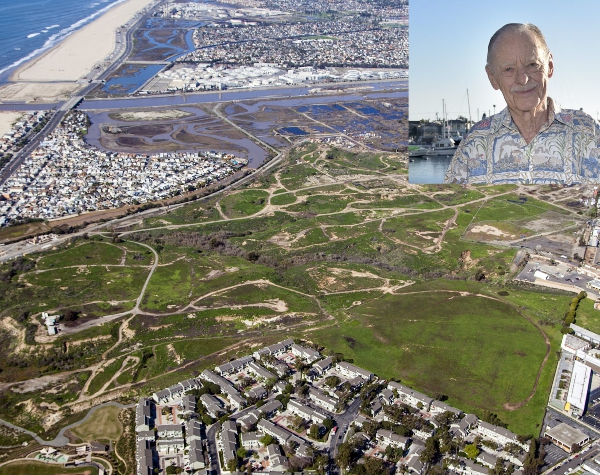
Frank Randall quietly built a fortune through stock investments and real estate deals largely in Los Angeles.
He and his wife, Joann, are making their legacy, though, in the wetlands and coastal bluffs of West Newport Beach.
And the Randall family’s years of under-the-radar giving back to Orange County are quiet no more.
In November, the Lido Isle couple announced a $50 million donation to the Banning Ranch Conservancy, a nonprofit dedicated toward preserving one of the largest remaining unprotected coastal open spots in Southern California.
It’s by far the largest of the $1 million dollar or higher charitable gifts disclosed in Orange County last year (see list, page 22).
It’s also a career capper for the 89-year-old Frank Randall, a longtime backer of environmental causes.
When asked if November’s gift could be considered his greatest accomplishment, Randall responded quickly—and with vintage understatement.
“I would say so.”
End to Development?
The 401-acre Banning Ranch site—whose borders stretch from the Santa Ana River to Coast Highway and Costa Mesa’s Westside—has been the site of controversy and litigation for decades. Development groups in recent years have looked—thus far unsuccessfully—to build homes, shops, and a hotel on a 70-acre portion of the site, with the rest of the land intended to remain open space.
The Randall’s gift is intended to help the conservancy buy the land back from the current owners, an entity operating under the Newport Banning Ranch LLC name.
A total price hasn’t been disclosed and negotiations are ongoing, officials said.
“Under nondisclosure agreements all I can say is $50 million gets us a lot further down the road,” said Banning Ranch Conservancy Executive Director Steve Ray.
Ray said that the Randalls have already given about $10 million of their pledge—and the conservancy hopes to have an agreement in principle on the price of those 401 acres by the end of the year.
The only stipulation?
“Frank made clear that ‘I want to still be alive,’ when the deal’s finalized,” Ray said.
Public Service Start
When he lived in South Pasadena in the early 1970s, Randall penned a letter to the editor opposing the extension of the Long Beach (SR-710) Freeway. Like-minded citizens urged him to run for the city council, which was split 2-2 on the issue.
Randall won a special election, and succinctly notes, “we killed the freeway.”
He didn’t run for re-election.
In 1977, Randall and Joann followed Frank’s grandfather down to Lido Isle because “the smog got to be too much in South Pasadena.”
The home he and Joann built sits on two lots on Via Lido Soud.
From their new home in OC, Randall continued to pick investment winners (see story, this page), but also began working more on philanthropic causes.
“As I became more affluent, I became more philanthropic. Open space preservation and make it available to the public … that’s my passion,” Randall said.
Early giving went to large, national organizations: National Audubon Society, The Trust for Public Land and The Nature Conservancy.
In 2012, Randall made his initial $5 million pledge to preserve Banning Ranch (see story, this page).
Other Gifts
Randall shares credit for his munificence with Joann, his wife of “40-plus years.”
“To be included in this wonderful thing that Frank is doing makes me feel very honored [and] humble,” Joann said.
“My deal is the humane society, but that’s my deal, he’s the environmentalist—and one of the last true gentlemen, that’s what Frank is.”
More’s in store. Randall said he intends to match the $50 million that he’ll give the Banning Ranch Conservancy with $50 million to preserve 50,000 acres in Kern County, a project with The Nature Conservancy to preserve a swath of property extending from Tejon Ranch to the Sierra Nevadas.
A love of the outdoors began in his youth.
“My father and I both loved going to Owens Valley,” said Randall, an avid backpacker. Warner Springs Ranch in East San Diego County has been another favorite, he said.
At 65, Frank Randall, father of two and grandfather of five, climbed Mount Kilimanjaro.
Sweet Mix
When Shelley Hoss, longtime president of Newport Beach-based Orange County Community Foundation, met Randall in 2017, the philanthropist was thinking locally with his donor-advised fund.
“They wanted to be more intentional and focused in their giving,” Hoss recalled after being introduced to the Randalls by Bo Glover, executive director of the Environmental Nature Center in Newport Beach.
“A really sweet mix” is how Hoss describes Randall’s other Orange County beneficence, citing $5,000 to $10,000 donations to the Orange County Rescue Mission in Tustin, Second Harvest Food Bank in Irvine, public television station PBS SoCal in Costa Mesa, and the Anaheim branch of Braille Institute of America Inc., along with recipients in Randall’s charitable sweet spot, the Audubon California Starr Ranch Sanctuary in Trabuco Canyon and Environmental Nature Center.
Hoss said people like the Randalls are doers, that they “want to see stuff that matters to them get done … and in their lifetime.”
Adds Ray, “this will crown Frank’s legacy, and [legacies for] quite a few of us.”
Follow the Oracle
The story of Frank Randall’s fortune is similar to those stories we still hear now and again: the school teacher or machinist who started buying U.S. stocks in the ’50s, rarely sold, and over the decades amassed a sizeable portfolio.
“I like Warren Buffett’s buy and hold idea—when I heard he was buying Geico, I bought some,” Randall said at his Lido Isle home.
Investor Buffett, estimated by Forbes to have a fortune approaching $80 billion, has written that insurance giant Geico rose over 5,000% while in his portfolio. And of course, the “Oracle of Omaha” has scored other big wins.
So has Randall.
Randall says he made 80-times his investment in drug company Warner-Lambert, which was bought by Pfizer in 2000, also a big win for him.
Investments are made by more than just mirroring Buffett.
“I make good investments based on education,” Randall said.
“I read a lot. I read Barron’s at the Newport Library after I play tennis.”
A&P to Lido House
Randall was born in Huntington Park, earned a business degree from the University of Nevada-Las Vegas, and worked five years as a broker with Dean Witter & Co.
A young Randall didn’t just buy and sell equities, but also commercial real estate, starting with strip malls in Los Angeles, “always anchored by A&P supermarkets.”
He bought apartment complexes, always near universities in Austin and Houston, Texas and Nashville, Tenn.
While the Banning Ranch development has become a cause célèbre among environmentalists, don’t put Randall in the “no more development in Newport Beach” camp.
Among his more recent real estate investments, he partnered with Newport-Beach developer Bob Olson—the Business Journal’s 2018 Businessperson of the Year—in the development of the Lido House hotel not far from his home.
Going Big
Banning Ranch Conservancy Executive Director Steve Ray had known the Randalls since 2012, when they made an initial $5 million pledge to the conservancy.
Then came an August 2019 phone call, and Ray’s friend Frank Randall—they’d talk, get together about every two weeks—sounded like he wanted to up his pledge tenfold.
“I said, ‘Excuse me, $15 million?’
He said, ‘No, no, 50, 5-0.’
“I said, ‘Thank you, thank you Frank,’” Ray recalled, “but I was trying to remain calm … there’s not many times you’re going to hear those words.”
Ray made one more sales pitch—convincing Randall and his lawyers to make the announcement at a November gala, and for Randall to take a public bow.
Initially, “he wanted to remain anonymous,” said Ray, noting that the family’s $5 million gift from 2012 had drawn some “initial suspicion he didn’t have the money.”
Sources familiar with the Randalls’ business dealings tell the Business Journal that the family likely has a fortune well in excess of $250 million.
A low-key approach to donations is not uncommon. Thirteen of the 61-largest charitable gifts on this week’s list count anonymous donors.
Ray’s pitch—honed by years of working in Hollywood as an actor, director and producer—worked.
At November’s gala, “We gave Frank our Angel Award, then I said, ‘there’s one more thing,’ and I invited Frank to the stage.”
“Frank announced to the group that he was increasing his donation to $50 million,” Ray said.
“It literally blew the roof off the structure.”
So much for anonymity.
Phineas T. and Banning Ranch
Delaware-born Phineas T. Banning may not be the best known of the emigres who built Southern California—there’s James Irvine, James McFadden, Father Junipero Serra and in modern times, titans like Robert Mulholland.
But Banning’s résumé stacks well.
He came West in the late 1840s, drawn by the San Francisco Gold Rush, “but fell in love with Los Angeles,” Banning Ranch Conservancy Executive Director Steve Ray said.
He came to a prescient realization, that the people and the commerce of this untapped region needed transportation.
He started with a shipping company of stagecoaches, and from there he went on to build or lead construction of the Port of Los Angeles and Southern California’s first railroad, which he’d sell to Southern Pacific.
Banning and his family became very wealthy.
“They owned all of South Bay pretty much,” Ray said.
Banning’s heirs were developers, and from the 4,000 acres the family owned in Coastal Orange County, their development efforts sprouted much of Huntington Beach and Costa Mesa, and their land also sprouted oilfields that were in use for decades.
Tour Banning Ranch today and you’ll see open space replete with water streams, coyotes, bobcats, wetlands of all types, vernal pools, coastal bluffs and arroyos and the mesa where the development was to occur—“an ecological staircase … a totally self-supporting environment,” Ray said.
Ray is not an environmentalist who believes in “stopping something without a better idea. Our idea is to preserve, acquire, conserve and manage the entire Banning Ranch as a permanent, public, open-space park and coastal preserve.”
That takes money. About $50 million for starters.
