

What do you get when you cross a Botox pioneer with the Bond King?
Henry Klassen is hoping that the combination—courtesy of the Gavin Herbert Eye Institute and the Sue & Bill Gross Stem Cell Research Center at the University of California-Irvine—will do no less than help cure retinitis pigmentosa, which causes blindness.
Klassen is an associate professor and director of the stem cell and retinal regeneration program at the eye institute at UCI. He and fellow assistant professor Jin Yang are working on a nonsurgical injectable therapy to treat the incurable condition, which erodes peripheral and night vision to the point of eventual blindness.
Their efforts form the basis of Newport Beach-based regenerative medicine company jCyte Inc., which was formed in 2012 and is a recent example of the symbiotic relationship between the marketplace and UCI—one of only 62 research universities in the U.S. and Canada, according to the Association of American Universities.
“You don’t go to every university and say, ‘Where’s your retinal research program,’” joked Klassen.
He said it remains a big challenge in academia to take research from bench to bedside—researcher jargon for the path from the laboratory to the clinic—and the path is even harder for stem cell researchers because of uncertainty around regulation of stem cells used in regenerative medicine.
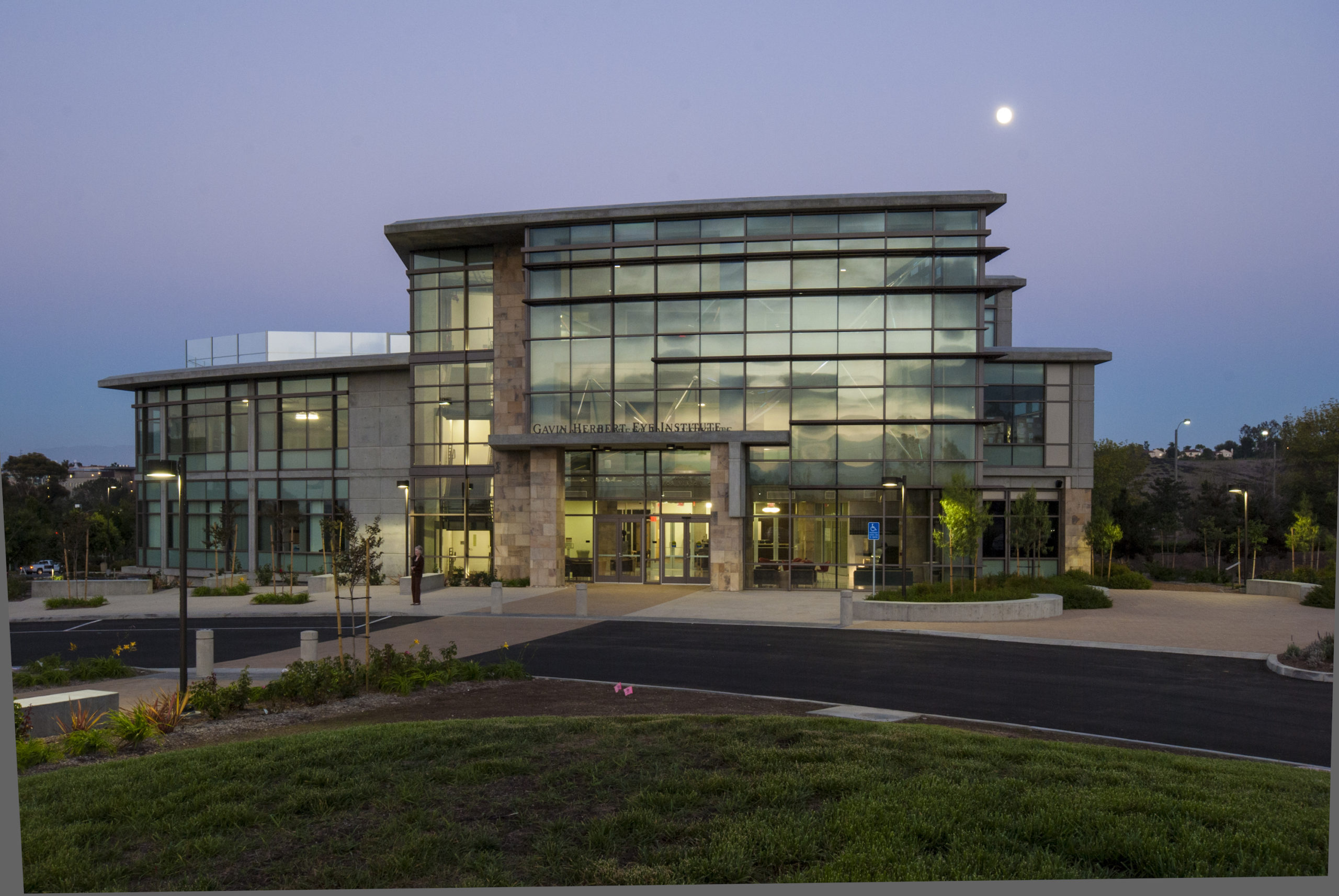
The eye institute that bears drugmaker Allergan founder Gavin Herbert’s name, and the stem cell center that carries that of legendary investment guru Bill Gross are crucial in providing Klassen a unique opportunity to move his research closer to commercialization.
The Grosses provided the initial $10 million donation to establish the center, and Gavin Herbert and his mother, Josephine Gleis, provided the naming gift for the institute in 2007.
“It was really good that we have the Gavin Herbert Eye Institute next to the Sue and Bill Gross stem cell center at the critical point of our development when we needed them,” he said.
Research Hits the Road
Retinitis pigmentosa is a rare, inherited degenerative eye disease causing vision loss as photoreceptor cells—rods and cones responsible for the initial detection of light––die off. The jCyte therapy injects retinal progenitor stem cells into the eye. The cells are intended to resuscitate dying photoreceptors and generate new ones.
Combining research with corporate expertise is essential to bringing treatments to patients, Klassen said.
“You can do stem cell research without a company, and most stem cell research are not affiliated with a company. But if this research were to move toward actual treatment, it’s going to be beneficial and mandatory at some point for you to form a corporate entity.”
He said jCyte was founded five years ago to bring capital and talents on board. “You have to bring in people with the expertise to deal with private-sector concerns, legal concerns.”
The company reported promising preliminary results from its initial clinical safety trial and plans to enroll 60 patients in a follow-on phase two trial testing for efficacy that’s scheduled to start by May.
The California Institute for Regenerative Medicine provided an $8.3 million grant to help fund the new trial, which started this month.
“At this point, it gets exponentially more expensive to move forward, to get this project that’s doing well to the finish line,” Klassen said, adding that OC’s robust concentration of ophthalmology companies and the eye institute’s standing in the industry are indispensable in the process.
The intellectual property from Klassen’s research belongs to the university via the Regents of the University of California, and JCyte licenses the technology from the university.
Interdisciplinary Approach
UCI has nearly 100 major research centers and institutions, including the stem cell center, the eye institute, the Institute for Clinical and Translational Science, the Chao Family Comprehensive Cancer Center and the Beckman Laser Institute & Medical Clinic. Together, they provide the infrastructure to support interdisciplinary researchers.
The stem cell center was established in 2006 as a stand-alone California Institute for Regenerative Medicine facility dedicated to preclinical and clinical research. Center faculty have obtained more than $170 million in grants and foundation funds, over $105 million of that from CIRM.
The facility has more than 88,000 square feet of lab and office space for stem cell research, clinical space for studies and a conference center.
The 70,000-square-foot, four-story eye institute is dedicated to developing therapies for a wide array of eye disorders, including macular degeneration, diabetic retinopathy, glaucoma, corneal disease and cataracts.
The project was funded completely through private donations, including by Jim Mazzo, global president of ophthalmology at Carl Zeiss Meditec AG; Bill Link, co-founder and a managing director of healthcare investment firm Versant Ventures; Newport Beach philanthropists Julia and George Argyros; and organizations such as Abbott Medical Optics, The Allergan Foundation, and the Arnold & Mabel Beckman Foundation.
The Herbert family has given or pledged over $24 million to eye care research at UCI, including a recent $5 million pledge to the institute.
Dr. Baruch “Barry” Kuppermann, professor of ophthalmology and biomedical engineering, and chief of retinal service at the eye institute, highlighted the unique collaboration between UCI and the industry.
“You really can’t get better than this if you are in ophthalmology. We are one of the top, if not the best, in the world,” he said, naming local ophthalmology companies including Alcon Inc. in Irvine, Glaukos Corp. in San Clemente, Allegro Ophthalmics LLC in San Juan Capistrano and Revision Optics Inc. in Lake Forest, among others.
Kuppermann said “it’s amazing” that the companies have a lot of people in executive roles who are current or former UCI faculty members.
Entrepreneurship
Klassen said that the fact he’s been able to do what he’s done with jCyte speaks volumes about the strength of the university’s approach to growing the number of projects that translate research into clinical application. “I wouldn’t have assumed it would have gone the way it did … the fact that it has worked here speaks for itself.”
He said jCyte, which has operated as a spinoff of UCI for the past four years, is likely to move from its operation on campus to an office in Newport Beach and is in the process of forming a four-person scientific advisory board.
“I am still wearing two hats,” Klassen said, “but I have to become somewhat of an entrepreneur … You either develop your science and hand it off to an entrepreneur, or you develop it to the point that you become an entrepreneur to carry it forth.”
He noted that he will likely transition “cautiously” into being more of an entrepreneur, though he doesn’t rule out the possibility of an acquisition.
