

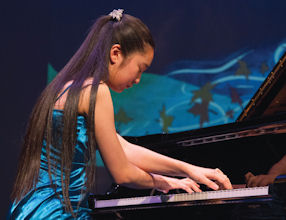
Fourteen-year-old pianist Valerie Narumi of Yorba Linda will join a couple of other young musicians who each will perform original pieces at the National Association of Music Merchants convention in Anaheim.
They are students of Buena Park-¬¬based Yamaha Corp. of America’s music education system, which comprises more than 50 U.S. schools that operate as free-standing classrooms or within instrument dealers.
Music education is part of Yamaha Corp. of America’s investment efforts to cultivate musicians across a range of ages and skill levels. The classes don’t generate profit, but there are plenty of other divisions that keep the business steady and growing, allowing the company to extend such services in scale and reach millions.
Yamaha Corp. of America—the U.S. arm of Yamaha Corp. in Japan—has been benefiting from recent increases in consumer demand for musical instruments after a dip in sales during the recession. The company is looking to grow further, in concert with the rising popularity of alternative musical genres and other potential avenues of business.
Yamaha set up a U.S. subsidiary in 1960 in Los Angeles and moved it to Buena Park in 1971.
The local unit’s core product lines include pianos, keyboards, marching band instruments, strings, synthesizers and home-studio equipment.
The company also operates an audio-visual division that markets home-theater products, plus a commercial audio division, which handles larger systems and installations at various venues.
Yamaha Corp. of America employs about 350 in a number of buildings at its OC campus, a rebound from a recession-era low point in 2009 when the company had to trim its workforce by 10%. It has about $560 million in annual revenue, three quarters of which come from musical instruments, according to Chief Marketing Director John Shalhoup.
The parent company had overall sales of about $3.6 billion in the year through March, up about 3% year-over-year.
“The good news as an industry is that we sell more units than we did in 2007 and 2008,” Shalhoup said. “There are more players. The average cost of an instrument or a piece of electronic equipment is a little bit lower because of lower [costs]… in manufacturing. But we’re actually putting more instruments in the hands of musicians. That’s the overall good news for the future.”
Yamaha manufactures its instruments in a handful of locations, including Japan, Indonesia and China. The conglomerate has other subsidiaries, including those engaged in resort operations, golf products and factory automation equipment.
Separately managed Yamaha Motor Corp. also is a key part of the Yamaha brand. The company, one of the largest manufacturers of motorcycles in the world, owns Yamaha Motor Corp. USA, which is headquartered in Cypress.
Yamaha Corp. of America Senior Vice President Rick Young said a few macro trends should help lift Yamaha’s music business.
“The number of kids in the general overall census is going to be going up in the next 10 years,” he said. “That’s a good sign for us. It’s a good market. We want to help the kids start early. … Another one of those trends is mariachi. The Hispanic population—it’s big here, but it’s big everywhere. Mariachi is starting to get big. That will be a huge trend over the next 10 years.”
Young also said a growing number of people are setting up home studios.
“That used to be more costly,” he said. “Now you can have a lower-end synthesizer and a pair of speakers, a computer and a program, and now you’re making music. Kids have these things set up, and they’re producers in their own right. That’s an exciting trend. There are more people that are either playing or otherwise trying to get involved in music.”
Yamaha Corp. of America is taking steps to cater to new and veteran musicians, including the recent addition of a strings-focused facility in its existing atelier, a 5,000-square-foot workshop in Buena Park.
“We build relationship, not by heavy-handedness but by getting involved, showing [instruments], asking for evaluations (of instruments),” Young said. “The atelier was … for brass instruments first, then woodwinds, and now strings. The main thing for the atelier is that you experiment, so there’s a little bit of R&D involved. There’s customization involved.”
Professional musicians and other visitors, such as music teachers, can work with Yamaha Corp. of America technicians and instrument designers, along with repair professionals.
“The atelier is really a service to the playing community,” Young said. “It’s also informational for us. We find out what they’re looking for.”
NAMM
Other efforts to reach out to musicians and nurture young pros include the Junior Original Concert program, an annual event at the NAMM show that showcases a handful of students at Yamaha’s music classes throughout the U.S.
Valerie and others—Megan Chang and Kylie Smith—are examples of the 700,000 students enrolled in Yamaha’s music program currently.
Yamaha Corp. of America’s local connections include ties to Disneyland and Orange County School of the Arts.
“Just about every instrument in Disneyland and California Adventure is a Yamaha,” Shalhoup said. “About 130,000 musicians from around the country come to Disneyland every year to get the experience of performing at the park and recording at their studio. There is a relationship with Disneyland that we couldn’t have with Disney World (in Florida) just because of proximity.”
Relationships also are important among the various divisions within Yamaha Corp. of America, according to Shalhoup and Young, who have helped lead the company through a shift in its structure after the consumer electronics unit merged into the overall music business last year.
The merger “did exactly what we wanted it to do, which was to increase the communication of all of Yamaha,” Young said. “Even though [the electronics subsidiary] was in the building just next-door, we were not communicating. Now the sales people really know one another, and we see cross-functioning in teams, which we just didn’t do before. It makes a huge difference.”
