

Japan-based Yamaha Corp. will consolidate its Buena Park-based music company with its consumer electronics subsidiary April 1, a move intended to cut costs and combine marketing efforts for the complementary business lines.
The U.S. business goes by Yamaha Corp. of America, and its headquarters here handles sales and marketing of the company’s musical instruments, which include keyboards, guitars, horns and woodwinds, among others. The instruments are made in Yamaha factories in Japan, China and Indonesia.
Yamaha Electron-ics is a subsidiary of Yamaha Corp. of Am-erica. It makes home audiovisual and theater equipment, including wireless systems and accessories.
The electronics unit, also based in Buena Park, takes care of sales and marketing, with manufacturing in China, Malaysia and Indonesia.
The consolidation follows a dip in business during the recession. It’s seen as a chance to save money by combining business lines with some crossover.
“The merger is mainly to leverage the brand name,” said Tom Sumner, senior vice president of Yamaha Corp. of America and president of Yamaha Electronics. “We had initially thought we’d keep a separate audio company like we did with the motorcycle part.”
Yamaha first set up a U.S. division in 1960 in Los Angeles and moved its headquarters to Buena Park in 1971. It split off its motor sports business with the creation of Cypress-based Yamaha Motor Corp. U.S.A. in 1977.
It’s taking the opposite tack with the musical instrument and audiovisual equipment businesses. Yamaha has operations in a number of global markets—including Mexico, France, Portugal, Korea and New Zealand—where the combination of the two units already has been tested.
“The U.S. is actually the last place we’re doing this,” Sumner said. “We’ve been merging the [audiovisual] side into the music side in other countries.”
The U.S. operation has been phasing in a consolidation plan.
“Logistics, shipping, finance, service and repair have been consolidated,” Sumner said.
Yamaha Corporation of America has 335 workers in Buena Park, while Yamaha Electronics accounts for another 41 jobs. The consolidation of the two isn’t expected to lead to job cuts or new hiring.
“There will be no effect on the employees,” Sumner said.
Cost cuts will come mostly on the administrative side.
Savings
“There will be some savings, like banking-related issues and preparing one set of tax documents instead of two,” Sumner said. “In general, we’ve already taken the savings, but there will be more in the years to come.”
Yamaha cut expenses with shutdowns of its only U.S. manufacturing plants in 2008, shutting plants in Michigan and Georgia. A couple of rugged years followed as the recession took hold.
Sales for the company’s North America region reached $1.1 billion in 2008 before tumbling to $724 million in 2010. The North American region had about $472 million of sales through the first nine months of its current fiscal year, which ends in March.
The company does not break out financial data for the U.S. operations.
“2009 was not a good year, and there was a rebound in 2010,” Senior Vice President Rick Young said. “It was a quick rebound, but not up to the level of 2008.”
Different segments of the musical instrument business were affected in different ways, according to Young.
“For the band and orchestra side, the rental side, sales were steady,” he said.
School Bands
School bands across the nation account for a major chunk of business. So does Disney, just a few miles away from Yamaha’s headquarters.
“OC is great because of Disneyland,” Sumner said. “It’s one of the largest employers of musicians. We’re the official supplier for Disneyland.”
Yamaha puts heavy importance on raising musicians and building relationships with artists.
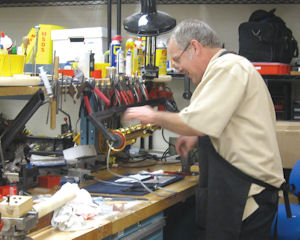
It has a portion of a former warehouse building built into a band and orchestra atelier—a workshop where industry experts carry out research and development. It’s also a place for artists to come in for testing and repairs.
The company also develops teachers for its chain of music schools across the country.
“Half (of the 50 or so schools) are inside individual dealers, and half are free-standing schools,” Young said. “Some schools can be found in OC cities, including Irvine and Fountain Valley.
The company plans to grow that side of the business in the future by adding curricula for older groups, Young said.
