

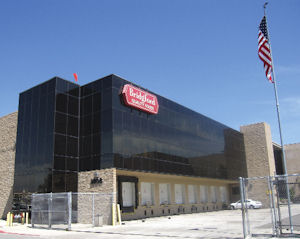
Anaheim’s Bridgford Foods Corp. is a bastion from the early days of local food manufacturing that is adapting to changing times.
The company, started in the 1940s, processes and distributes snacks and refrigerated and frozen foods to grocery stores, hotels and restaurants.
Like others, it’s dealing with ongoing rises in commodity and oil prices. Higher fuel costs have led the company to consolidate delivery routes, trim operations in less profitable markets and contract with distributors to replace parts of its own distribution network.
“We’ve made some pretty big changes in the way we distribute,” said Chairman Bill Bridgford Jr. during a tour of the company’s 100,000-square-foot plant in Anaheim, where it makes frozen bread dough and buttermilk biscuits.
The company cut the number of routes for its 250 trucks by 35%, according to Senior Chairman Allan Bridgford, Bill Bridgford’s uncle.
Initiatives also have improved operations in Chicago, the company’s hub for dry sausage products and beef jerky.
Bridgford ranks No. 53 on our 2011 list of the largest public companies here that starts on page 14.
Fluctuating Market
The company’s shares bounce around with the commodity market. They’re down about 5% in the past 12 months to a recent market value of about $110 million.
Bridgford family members own about three-quarters of the company’s stock.
The company posted a $4.3 million profit in 2010, despite a 4% drop in sales to $117 million and higher costs.
The outlook on commodities for this year remains uncertain.
Bridgford isn’t looking to the futures market to hedge against rising prices. The company tried that unsuccessfully 25 years ago, Allan Bridgford said.
“That’s why we don’t do it,” he said. “We buy based on need.”
“We pretty much roll with the markets,” Bill Bridgford said.
That means handling ups and downs with innovations and adjustments at Bridgford, a relatively small player competing with big names such as Nestlé SA, Kraft Foods Inc. and Sara Lee Corp.
With efficiency gains in distribution, Bridgford is looking to boost prices on
its products.
“Our main product ingredients have absolutely ballooned,” Allan Bridgford, 76, said. “We’re trying to pass some of that along, but we can’t get all that back.”
Ongoing consolidation in the grocery industry makes passing on higher prices tough.
Only a handful of supermarket chains remain in Southern California Thirty years ago, there were more than 20.
Sales to Wal-Mart Stores Inc. make up about 10% of revenue.
Innovation has been a key ingredient to Bridgford’s longevity and holds the potential to offset rising overhead.
Under the direction of Baron R.H. Bridgford, who runs the Chicago plant, the company introduced several items in the past year, including beef and pepperoni stick value packs and turkey bites.
In the frozen food division, new offerings included a variety of doughs, including sweet yeast, sub and hoagie rolls, whole grain and white whole wheat rolls.
One newer product—cinnamon-flavored monkey bread developed a few years ago—has been a hit at grocery stores, restaurants and hotels.
Bridgford also buys products for resale such as cheeses, salads, party dips, Mexican foods, nuts and other deli items.
About 150 frozen food products are sold directly or through wholesalers and distributors to more than 40,000 grocery stores, restaurants and other businesses.
Bridgford’s refrigerated and snack division sells about 220 items to 28,000 supermarkets and convenience stores in 49 states and Canada.
The company employs about 520 people nationwide and 135 in Orange County.
Humble Beginning
Photos on the walls of Bridgford’s Anaheim headquarters reveal its humble beginnings.
The size of its local plant hasn’t changed much through the years, although operations inside have.
In one of the earliest photos, taken around 1943 when the factory was bought from Stanley and Ernie Chapman, lush orange groves surround the building.
Allan Bridgford remembers those days as a child when he was paid a buck a day to open and sort mail.
When it hit high noon, he would unhitch his trusty horse Pedro and ride into Fullerton to catch a movie and ride back before closing time.
Back then pigs, cattle and sheep filled the trails “before their last supper,” as Allan Bridgford put it.
The family got out of the meat business around 1963, when the adjacent Riverside (91) Freeway still was two lanes.
It was around that time that H.H. Bridgford, Bill Bridgford’s grandfather, stumbled upon a discovery that would change the family business forever.
H.H. Bridgford, Bill Bridgford and some others were making pizzas for themselves and ran into some problems. They stashed them in the freezer.
When they took them out of freezer the next day, the bread rose.
“A light went on with my grandfather, who was a very innovative guy,” Bill Bridgford said. “We were the pioneers of frozen bread dough.”
That spurred the move into retail food.
The company soon expanded to Dallas and then bought its first East Coast location in Secaucus, N.J., which operated for 30 years until the company relocated it to Statesville, N.C.
The company has remained family run since the early 1930s when Allan Bridgford’s father ran a butcher shop in San Diego.
At least 10 family members work for the company. Most started at or near the bottom. One of Bill Bridgford’s first jobs was as a delivery driver.
His 29-year-old son Michael Bridgford, part of the fourth generation in the business, jokes that he started at the top—painting the roof.
Now he’s plant manager in Anaheim. His 22-year-old brother Nick Bridgford helps with customer relations and routing.
Bill Bridgford’s brother Blaine Bridgford run a Dallas plant.
“The family atmosphere is very important here,” Michael Bridgford said. “It’s a place you actually look forward to coming to,
working with your family and people you’ve developed close relationships with over the years.”
