

The local fitness industry has created a new workout routine: pumping up empty shopping centers.
Some of the area’s biggest gyms—including those run by Irvine-based LA Fitness Inc., San Ramon-based 24 Hour Fitness USA Inc., and Irving, Texas-based Gold’s Gym International Inc.—have bulked up their local presence with a number of lease deals over the past year.
The six largest fitness-related deals reported here of late combine for close to 300,000 square feet of retail space. That’s roughly the size of a typical office tower in the John Wayne Airport area.
The gyms have snapped up big chunks of space mostly left empty by retrenching former retailers such as Mervyns and Circuit City.
The gyms also have given the cavernous spaces higher-end looks, prompting a turnabout in perceptions about their place on the local retail landscape.
It wasn’t long ago that gyms were criticized for dull appearances, taking up too much parking and drawing a base of customers with no interest in shopping elsewhere at a center.
“Gyms used to be seen as the pariah of the shopping center—now they’re the prettiest girl at the school dance,” said Ian Brown, senior vice president for the retail group of Santa Ana-based Grubb & Ellis Co., who works in the brokerage’s Newport Beach office.
Perceptions also have gotten a backhanded boost from the economic downturn, which left a lot of Orange County landlords struggling with leasing and rental rates (see related story and data, page 33).
Recent indications of an economic rebound have yet to give the local retail market a good shake. Vacancy rates throughout the county closed 2010 at 9.9%, up from 8.5% the prior year, according to data from CB Richard Ellis Group Inc.
Vacancy rates were closer to 3% at the peak of the market in early 2006, according to the brokerage’s data.
The string of gym deals included several that were among the largest local retail leases during the past year. That helped stop the bleeding in 2010 and perhaps set the stage for solid gains this year.
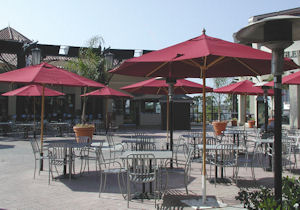
At Costa Mesa’s Triangle Square mall, a recently struck, 59,000-square-foot deal with 24 Hour Fitness is the biggest new lease the embattled shopping center’s seen in years.
Triangle Square’s recently revamped ownership group, TSQ Venture Partners LLC, a unit of Newport Beach’s Greenlaw Partners, is using the gym as a keystone of efforts to rebrand the center. TSQ wants to make Triangle Square more of an entertainment-driven location rather than a traditional retail center.
Gold’s in Fullerton
In Fullerton, Gold’s Gym is slated to open a 40,000-square-foot facility at Amerige Heights Town Center. The site previously was a Linens ‘n Things store.
Newport Beach’s Irvine Company is adding a pair of gym tenants at two shopping centers it owns—an LA Fitness at The Crossroads Irvine, and a 24 Hour Fitness at The Market Place on the border of Tustin and Irvine. The two deals account for more than 100,000 square feet, taking over empty spaces left behind by shuttered Mervyns and Circuit City stores.
Most of the latest leases are for 15 years or more, offering stability for several shopping centers that have seen plenty of tenant turnover as a result of the downturn.
“With a solid, credit-tenant, and a 20-year term, there’s some real merit to getting these deals signed,” said Phil Voorhees, senior vice president for the national retail investment group of CB Richard Ellis Group
How profitable the leases are for individual landlords is open to some debate.
Last year, Santa Monica developer Watt Commercial Properties announced it signed LA Fitness to a 15-year lease at its Alicia Towne Center, at the corner of Alicia Parkway and the San Diego (I-5) Freeway in Mission Viejo.
Watt said the deal, for 58,645 square feet of space, was for $19.5 million. On a monthly basis, that works out to rent of about $1.84 per square foot.
In South County, the average monthly rental rate for retail space currently runs roughly 33% higher than that, according to brokerage data.
The lease rates for the fitness center might be lower than the norm, but the numbers can still make sense for landlords, said Voor-hees, who works out of the brokerage’s New-port Beach office.
In the case of a gen-eric former Mervyns space—in many cases built specifically for the chain—a rate of $1.75 to $2 per square foot for a gym tenant could be a nearly 50% hike over what the retailer had paid, said Voorhees.
The tricky part for landlords is the cost of tenant improvements, which most building owners now are subsidizing.
Gyms “pay a good rent, but you have to put them in the building,” said Grubb’s Brown.
For a smaller boutique health club—in the 10,000-square-foot range—tenant improvement costs can run $80 to $100 per square foot, said Kevin Ivey, head of business development for KPRS Construction Services Inc. of Brea.
Showers, flooring for basketball courts and locker rooms are among the more expensive aspects, he said.
With a larger gym of 60,000 square feet, which typically features up to 40,000 square feet of open space, costs can run $60 per square foot, said Ivey , whose company is working on a boutique health club in Newport Beach.
“Mechanical systems for a gym are different that that of a (retailer),” he said. “Apart from solid walls, and core elements of the building, there’s not much to work with.”
Even at a discounted $40-per-square-foot rate on tenant improvements, a landlord looking to bring in a 60,000-square-foot gym tenant can expect to pay $2.4 million, Brown said.
$6M in Improvements
At Mission Viejo’s Alicia Towne Plaza, the total construction costs tied to putting in a LA Fitness are expected to be $6 million or more, according to the developer. The two-level building—another former Mervyns—once totaled 83,857 square feet but will be smaller upon completion of the project.
Whether there’s much more in the way of new gym leases for the remainder of 2011 remains to be seen. Retail brokers said that much of the area’s best locations for bulk space vacated by Mervyns and others has been taken.
“A lot of it got soaked up already,” said CB Richard Ellis’ Voorhees.
Beyond gyms, retailers such as Wal-Mart, supermarkets and ethnic supermarket chains have grabbed a good deal of space locally, Brown said.
“I think the flood of vacant space (coming back to the market) is pretty much over,” he said. “The people who were going to go are gone, but a lot of people are alive.”
