
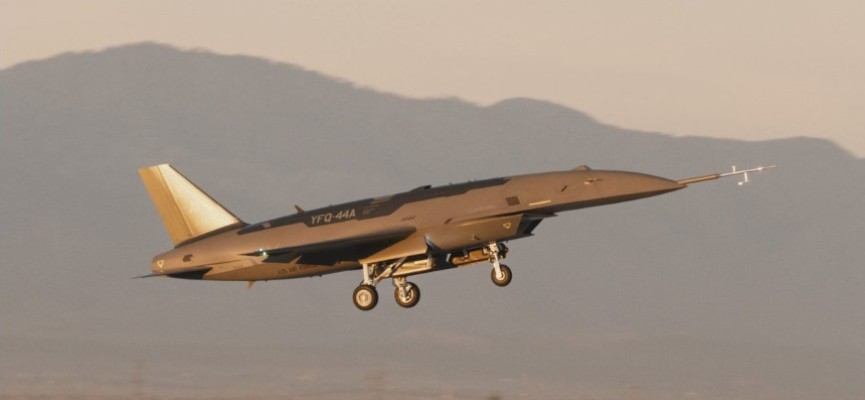
Defense company Anduril Industries has taken the first steps toward full-scale production of its unmanned fighter jet at its mega-factory outside Columbus, Ohio.
A brief posting on X on March 23 said the construction has started, while Anduril Chairman Trae Stephens told Bloomberg TV that “we’ll be producing a run rate of 120 to 150 aircraft.”
An Anduril spokesperson later made it clear that full-scale production of the aircraft, called the YFQ-44A, is still a way away. The aircraft is part of the U.S. Air Force’s Collaborative Combat Aircraft (CCA) program.
“The line that we have today is able to produce up to 50 aircraft per shift per year. At three shifts per day, that means 150 aircraft per year,” the spokesperson said. “That is production capacity, not necessarily the demand from the CCA program.”
The spokesperson emphasized: “The numbers we’ve shared above are production capacity, not necessarily the number of aircraft we’re making today.”
A few dozen people are now at work at the giant Ohio factory known as Arsenal-1 “with around 250 by the end of the year.”
The weapons-making plant will eventually cover 5 million square feet and cost nearly $2 billion to build.
Prototypes to Start
Anduril is competing against rival General Atomics for a full-scale Air Force manufacturing contract for the AI-guided aircraft.
In January, Anduril reported that the initial batch of YFQ-44A aircraft would be classified as “prototypes” with the first models expected this summer.
Asked whether Anduril’s YFQ-44A been certified for combat use by the Air Force, or whether further testing is needed, the company spokesperson replied: “Testing is still in progress.”
“The production line at Arsenal-1 is designed to be responsive to future demand,” the spokesperson said. If production capacity needs to expand “we can easily do so by adding additional stations to the existing production line.”
$60B Valuation Sought
Anduril, co-founded by OC tech billionaire Palmer Luckey, reportedly has been angling for billions of dollars in new funding that would raise the company’s valuation to $60 billion.
The potential increase would nearly double the current valuation of the company. The firm reached $30.5 billion after its last private funding round in June. That valuation doubled from 2024.