

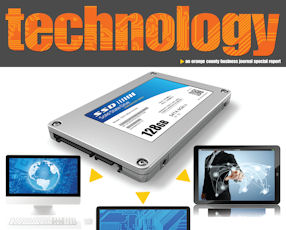
Orange County’s legacy developing memory products and chips decades ago laid the groundwork for one of the industry’s fastest-growing segments today.
And while the solid-state drives market is still emerging, its growth prospects have prompted some 500 companies around the world to enter the fray since its inception five years ago.
The stakes are high, and the competition is fierce among both big manufacturers and startups, similar to the early days of the hard disk drive market. But three local technology companies have risen to the leader board as other established competitors here vie for a piece of the pie.
Irvine-based Western Digital Corp., Kingston Technology Co. in Fountain Valley, and Santa Ana-based STEC Inc. cracked the top 10 list of SSD sellers last year, according to Englewood, Colo.-based market tracker IHS Inc.
That list also includes No. 3 Toshiba Corp. of Japan, which has two local units heavily tied to the emerging line of products.
SSDs, which use chips instead of spinning disks to store data, are considered to have better performance, higher reliability and longer battery life, though high costs have curtailed widespread adoption.
Now and Then
Orange County’s history in memory products dates back more than two decades. Early entrants included Santa Ana-based Simple Technology, which was launched by STEC cofounders Manouchehr Moshayedi and his brother Mike; Telecomputer Inc. in Westminster; and Rancho Santa Margarita-based Viking Interworks Inc., which was acquired in a 2001 fire sale by Sanmina-SCI Corp. in San Jose for about $15 million.
The early work done by those companies led to advancements in memory products that evolved into today’s generation of SSDs.
The drives are expected to gradually replace hard drives in corporate networks and are increasingly being deployed in consumer products, such as ultrabooks and notebooks, and in industrial devices, such as automated manufacturing equipment, kiosks and video surveillance systems.
Global sales are expected to grow at a 65% compounded annual growth rate over the next five years to some $20 billion, according to IHS.
The segment will account for about $3.9 billion, or 13%, of the $30 billion NAND flash memory market this year, forecasts Scottsdale, Ariz.-based IC Insights Inc. NAND flash is the primary storage component in SSDs.
Western Digital, which was No. 7 with a 4.4% market share and $243 million in solid-state drive sales, entered the segment in early 2009 after it acquired Aliso Viejo-based SiliconSystems Inc. for $65 million.
The Business Journal estimated at the time that SiliconSystems generated $20 million to $50 million annually from its SSDs geared for cellphone base stations on small, defined wireless networks.
Western Digital has long eyed growth in the corporate sector, which generally has higher margins, to complement its long-standing presence in the consumer hard disk drive market.
Skycera
It backed San Jose-based startup Skycera Inc. in March in a $51 million financing round because it was attracted to the company’s 19/20-nanometer solid-state drives billed to replace traditional corporate hard drives.
Western Digital, which was Skycera’s initial outside investor, is the world’s largest disk drive maker in units sold and the county’s second-largest public company, with $12.4 billion in annual revenue.
Kingston Technology, No. 9 on the list, partnered with Santa Clara-based Intel Corp., the world’s largest chipmaker, to introduce its first solid-state drive product in 2009, geared for the corporate and server market.
San Diego-based Qualcomm Corp., a chief rival to Broadcom Corp. in Irvine, was among Kingston’s first corporate customers. Kingston, with a 3.2% market share, has since installed SSDs in more than 5,000 Qualcomm computer systems.
The company, which sees some $5 billion in annual revenue, has posted two straight record quarters in the SSD segment, thanks to a spike on the consumer side of the business.
“Our mix has certainly changed over the last couple of years,” said Kingston SSD business manager Ariel Perez. “We see a bigger and bigger acceptance of SSDs as the most effective upgrade to your system.”
Much of the growth was pinned to lower pricing on SSDs, which helped boost sales of ultrabooks and other consumer electronics, as well devices geared for the corporate sector, Perez said.
Kingston is the world’s largest memory products maker for computers and consumer electronics.
STEC, which is No. 10 on the list with a 2.9% solid-state drive market share and $162 million in sales, has seen its dominance in flash drives used in corporate data rooms erode over the past few years. It once had an iron-clad hold on what’s referred to as enterprise-grade solid-state drives when it helped usher in the segment in 2009. The company saw its market value top $1.5 billion that year, posting record sales of $354.1 million.
Sales in 2012 fell to $168.3 million, down more than 45% from 2011. It had a market value of about $160 million last week.
The company recently initiated a direct sales program in a bid to move beyond original equipment makers and win business in several markets, including social media and telecommunications.
“There is a bigger market out there that has demand for these types of products,” interim Chief Executive Mark Moshayedi told the Business Journal. “The new strategy helps with old strategy.”
STEC lost its early lead in the SSD market as OEM customers sought second and third suppliers. Revenue began to slide even as global sales for solid-state drives escalated.
STEC’s inability to swiftly react to changing market dynamics has prompted investors to call for sweeping changes to its management team and directors, and it appears headed to a proxy fight with its largest investor, Balch Hill Partners, a San Francisco-based private equity firm.
Other Players
Taiwan-based Transcend Information Inc., which has its U.S. headquarters in Orange, targeted industrial applications with its first line of SSDs, released more than five years ago. It designed the products to withstand extreme temperatures, from the drilling tundra of Alaska to the earth’s smoldering depths below the surface.
The emphasis on developing the drives to meet special requirements and offer high reliability has served the company well as it moved into other products, such as medical equipment, ATM terminals, self-checkout kiosks and slot machines.
“The pie is getting bigger and bigger,” said General Manager Clarence Chan, who estimates that SSDs now account for about 10% of the company’s $1 billion in annual sales.
Rancho Santa Margarita-based Virtium Technology also singled out the industrial market, offering solid-state drives aimed toward telecoms and the medical, transportation, media and automated-manufacturing sectors after the company’s launch in 1997.
“We selected a market segment that we had the best chance to succeed without infrastructure,” said cofounder Phu Hoang. “We were profitable from month one.”
Virtium counts some of the world’s largest companies as customers, including Alcatel-Lucent, Boeing, Emerson, General Dynamics, General Electric, IBM, Intel and Motorola.
Toshiba, which invented NAND flash memory 25 years ago, entered the SSD segment about four years ago with a line of laptops. The consumer business line is still emerging at Toshiba’s Digital Products Division, a unit of Irvine-based Toshiba America Information Systems Inc.
“This is a startup for us,” said Maciek Brzeski, vice president of product marketing and development, branded storage products. “From where we are right now, we’re focused on upgrades to existing laptops.”
Another Irvine-based Toshiba unit, Toshiba America Electronic Components Inc., handles the corporate and data center side of the business.
Going Forward
2013 is expected to be a challenging year in the SSD market as the segment’s big flash-chip suppliers project shortages. The growing popularity of Samsung and Apple smartphones and tablets are partly to blame.
Not to mention the fact that Samsung is also one of the segment’s largest chip suppliers, which could curtail gains for newcomers.
“If you don’t have a relationship with Samsung, Toshiba and SanDisk,” Transcend’s Chan said, “you’re not able to get these chips.”
