

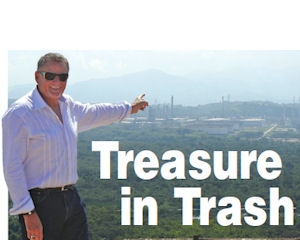
Technology developed by a quiet Newport Beach company will be at the core of a power plant in Brazil that’s expected to produce biofuels and other renewable energy sources from the world’s largest and most notorious garbage dump.
FirmGreen Inc. will own a portion of a 5-acre plant in Rio de Janeiro. It will be the company’s first large-scale project to convert methane gas into clean energy, taking on the task at the mountainous Jardim Gramacho dump, which collected some 8,000 tons of garbage every day until the Brazilian government shut it down in June.
The company partnered with Gás Verde SA and Petroleo Brasileiro SA on the Novo Gramacho Landfill Gas Project, which holds the potential to produce the equivalent of 22 million gasoline gallons of compressed natural gas annually.
The 30-year project is valued at more than $100 million, with FirmGreen in line for a third of the deal.
The plant, scheduled to open in October, will serve as a testing ground for FirmGreen as it moves from an engineering and consulting firm to more of a licensing company with a long-term goal of developing power systems in other emerging countries where energy costs are much higher than the U.S.
“Uniquely Positioned”
“FirmGreen is uniquely positioned for that,” said Chief Executive Steve Wilburn. “We’re trying to lessen the cost of renewable energy so it can be more competitive.”
The company developed a technology that extracts methane gas from landfills, cleans it and converts it into clean biomethane gas. Clean methane from the Novo Gramacho project will be transported through a 3.7-mile pipeline and sold to a nearby oil refinery run by Petroleo Brasileiro.
The plan calls for some 100 metric tons of liquid carbon dioxide—another form of clean energy—to be captured through the methane extraction process annually.
Some of that yield will be used to help local residents start new businesses that cater to the needs of the Jardim Gramacho community, according to Wilburn. Carbon dioxide can be converted into dry ice, which can be used to cool areas or refrigerate foods and other items. It also can be packed into pellets and used to blast graffiti off walls or clean other surfaces.
“We can enable people and empower them,” said Wilburn, a chemical engineer by trade who’s spent more than three decades in the energy sector with stints as an engineer and executive at Mansanto Corp., NASA and Allied Signal Inc.
Jardim Gramacho has for years attracted hundreds of pickers who every day combed through heaps of garbage searching for recyclable materials to sell.
Documentary
Their plight was chronicled in the documentary Wasteland, which garnered an Academy Award nomination in 2011 for its poignant portrayal of life on the landfill, and an artist’s wish to lift some of them out of poverty and raise awareness of conditions facing his homeland.
The site rises to 300 feet and spans some 320 acres on the outskirts of the city—roughly the size of 250 football fields.
The plant also is expected to produce enough electrical energy to offset 80% of its own power needs, easing demand from Rio de Janeiro’s taxed power grid.
FirmGreen will license its technology to Gás Verde, the majority owner and operator of the plant.
FirmGreen sees about $200 million in revenue annually, a figure it hopes to grow in coming years as licensing becomes a larger part of the business model, according to Wilburn.
The company posted its first profit last year.
Wilburn isn’t big on bureaucracy, government funding or outside investment. He started the company in 2004 with his own money and hasn’t sought government subsidies or venture capital.
Gás Verde reached out to him about five years ago after FirmGreen ran some successful pilots in New Jersey and Ohio.
The connection to Gás Verde helped FirmGreen win a design bid for the plant in Brazil in 2008, and a construction bid in 2010. It beat out two much-larger competitors, Paris-based Air Liquide SA and The Linde Group in Munich, Germany, for the work.
$48.6M Loan
Gás Verde was approved for a $48.6 million loan from the Export-Import Bank of the United States to help fund the Novo Gramacho project. The loan application counted on FirmGreen’s technology, and the Export-Import Bank spent nine months checking it over, according to Wilburn.
The loan generated 165 new jobs, with some at FirmGreen and the bulk at subcontractors in Indiana, Wisconsin, Ohio, California, Michigan, Missouri, Texas and Brazil.
FirmGreen now employs about 60 people spread over its headquarters here, a software lab in Kokomo, Ind., and other scattered projects ranging from Puerto Rico to the Inland Empire, where it will soon begin work extracting and converting methane gas to fuel municipal fleets.
FirmGreen has kept a low profile from its headquarters until now.
“We weren’t ready to talk, but we’re ready now,” Wilburn said.
