

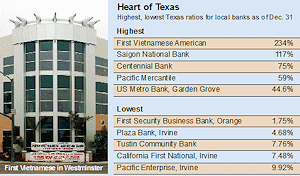
A commonly used measure to gauge the health of banks shows that two that were started to serve the county’s Vietnamese hub are operating at highly distressed levels.
First Vietnamese American Bank and Saigon National Bank, both of Westminster, scored poorly in a test of their bad loans and real estate versus their cash reserves, according to a report for the Business Journal by Irvine-based bank investor and consultant Carpenter & Co.
At the start of the year, First Vietnamese scored 234% on what’s known as a Texas ratio, a measurement of bank health where the lower the score the better and anything higher than 100% is considered a sign of teetering.
Saigon National had a Texas ratio of 117%.
“The Texas ratio can’t be applied as an absolute, but it’s certainly a good way to identify problem banks,” said Grace Wickersham, senior vice president at Carpenter & Co.
The Texas ratio compares a bank’s bad loans to how much its shareholders would be owed if it failed. Indebted real estate controlled by banks is part of the equation.
Analysts at Royal Bank of Canada’s RBC Capital Markets came up with the ratio in the 1980s while looking at banks in Texas.
The majority of banks and thrifts based in the county score well on Texas ratios. Entering 2010, 23 of 27 homegrown banks and savings and loans were operating at levels considered safe by analysts.
As a group, the average ratio was 32%, below the county’s long-term average of 35%, according to a separate review of Texas ratio data by Rancho Santa Margarita-based bank consultant Timmons Co.
“Those who’ve survived the savings and loan crisis in the ’80s and subsequent downturns are still doing relatively well compared to what we’re seeing nationally,” Timmons said.
First Vietnamese Bank’s Texas ratio has been steadily increasing in the past year, according to Carpenter & Co.’s survey.
The bank’s chief executive, Benjamin Palma-Gil, was unavailable for comment last week. Toni Umphreyville, First Vietnamese’s chief financial officer, declined to comment.
At the end of 2008, First Vietnamese’s Texas ratio was 31.5%. It took a noticeable leap between the second and third quarters of last year when it went from 47.8% to 157%.
The bank is said to be looking to raise money, according to Gary Findley, an Anaheim-based banking analyst and consultant.
First Vietnamese opened with fanfare in 2005 as the first bank to specifically target Vietnamese-Americans and their businesses in Little Saigon, which spans Westminster, Fountain Valley, Garden Grove and Santa Ana.
The area is home to an estimated 200,000 Vietnamese.
Former chief executive Hieu Nguyen started the bank with investments from local business owners, bankers and international investors.
Saigon National opened a few months after First Vietnamese in 2005, also targeting Little Saigon.
The bank has been working to pump up its reserves, according to Roy Painter, chief financial officer. At the end of January, Saigon National raised about $2.5 million in a private placement, he said.
“It certainly gives us greater operational capabilities,” Painter said. “In terms of the Texas ratio, it will put us well underneath 100%—the level everyone looks at.”
Saigon National Bank is in the process of raising another $2.8 million through a second private placement, according to Painter.
The bank also has a new chief executive, Bill Lu, and chief credit officer, Patrick Siu.
“During the economic downturn, a handful of our loans had difficulty,” Painter said. “Our focus is on resolving those issues.”
Two other local banks have Texas ratios less than 100% but higher than 50%, enough to cause concern, according to bank consultant Timmons.
Centennial Bank in Fountain Valley, with $848.4 million in assets at the end of 2009, had a ratio of 75%. A year earlier, its ratio was about 2%.
Officials at Centennial Bank didn’t return requests for comments.
“Centennial isn’t a traditional commercial bank,” analyst Findley said. “Their history is more as an industrial loan, higher-octane commercial financing operation. They deliberately take on more risk including higher delinquency factors into their business plan. The trade-off is that they also make higher profit margins.”
Costa Mesa-based Pacific Mercantile Bank, the county’s largest homegrown bank, started the year with a Texas ratio nearing 60%.
At the end of 2009, the bank had $51 million in nonperforming loans. Another $10 million on its books were foreclosed properties the bank had taken ownership of.
About $20 million of those nonperforming loans have been restructured, according to Ray Dellerba, Pacific Mercantile Bank’s chief executive.
Accounting rules don’t allow for those loans to be applied on its books until payments are more mature, officials at the bank said.
Another factor the Texas ratio doesn’t include is cash and other assets at Pacific Mercantile Bank’s holding company, Costa Mesa-based Pacific Mercantile Bancorp.
The holding company has “seven figures” in cash, Dellerba said.
